An Ode to Emma Stone, Easy A

  • Subscribe to our RSS feed.
  • Twitter
  • StumbleUpon
  • Reddit
  • Facebook
  • Digg

Sunday, 16 September 2012

Sylvia Plath Annotates the Great Gatsby

Posted on 09:49 by Unknown

Screen shot 2012 09 16 at 12 46 59 PMTwo things I adore in this world are Sylvia Plath and F. Scott Fitzgerald (and Kate Beaton, above*) - I choose the word "things" carefully as both are human ideas shrouded in fairly impenetrable (and self-created) mystique. Both have moments where they maximise the worst clichés about themselves.

The page below, drawn from Sylvia Plath's own copy of The Great Gatsby, (the entire book is available at the University of South Carolina) demonstrates the worst of Sylvia's Plathisms.

NewImage

Reading this, I had a sudden vision of Plath thumbing through classic novels and trolling them, taking long whiffs of Virginia Slims and expelling "Oh, l'ennui" onto countless pages of text that mirror Plath's youthful view of herself as described in The Bell Jar.

*Main image credited to Kate Beaton's magnificent Hark! A Vagrant! I've bought a copy of her book, and so should you.

Read More
Posted in Books, Fitzgerald, Sylvia Plath | No comments

Saturday, 15 September 2012

A Town Called Mercy, Or, The Doctor Grapples with Universal Human Rights

Posted on 15:19 by Unknown

NewImage

A Town Called Mercy may be the finest episode of nu-Who to date.

As in School Reunion, Toby Whithouse takes full advantage of the meta-concept that he Doctor may be the protagonist of this show called Doctor Who, but within the narrative universe, he's really just a minor character. All that business about being The Oncoming Storm really doesn't affect the day-to-day lives of, well, anyone in the universe.

It's an ambitious concept for the show to deal with, which may be why the revived show has previously limited the question to the Doctor's impact on his human (and very mortal) companions.

A Town Called Mercy grapples with a particularly messy issue - is the Doctor really a hero, or is he the intergalactic equivalent of the IMF, an arbiter of "correct behavior" with a worldview and a mission statement that refuses to adapt to cultural differences?

Screen shot 2012 09 15 at 6 14 10 PM

Thankfully, Whithouse doesn't feel the need to answer that question fully - he takes the decisions out of the Doctor's hands. Each of the key players actually make their own choices. Isaac chooses to protect Jex, the Gunslinger has moral heft to guide his own mission, and Jex decides to face his greatest fear - his guilt.

The central moral quandary leads us to one of the most wonderful conversations ever between a Doctor and his companion. Amy finally proves that maybe, just maybe, she actually knows him a little better than everyone else.

I love how their dialogue mirrors a famous scene from Genesis of the Daleks (below). My, how the tables have turned, eh Doctor? (watch clip from :48 to go straight to the scene in question).

The Marvellous Mrs. Pond

Screen shot 2012 09 15 at 6 11 47 PM

Speaking of Amy, the writers have finally figured her out. I wrote last year that she wasn't a character with any clear reason for being, lacking real desires or motivations. But now she feels like a more defined character.

There's two explanations for this:

  1. The writers intended all along that she wouldn't become her own character until she made a life without a Doctor, to make a facile point.
  2. The writers realized that her reactions to having and losing her baby were inadequate and unrealistic, so they've written in hints of severe post-partum trauma. This trauma allows her to be more empathetic, and yes, more ferocious.

Either way, she now feels like a living, breathing human being, instead of a sassy Scottish china doll. She's still clumsy and childish but now we know that these traits are external manifestations of deep-set emotional pain.

So that was long-winded, eh? I'm genuinely excited to see what comes next. Steven Moffat's era finally seems to be living up to its initial promise.

Read More
Posted in Doctor Who | No comments

Wednesday, 5 September 2012

Doctor Who and the Asylum of the Daleks

Posted on 05:40 by Unknown

NewImage

Welcome back! Apologies for lateness, but I just got back from India after a wedding and a funeral, and attached emotions thereof. But onward and geronimo! As always, don't read if you haven't seen it.

Once you get past the supremely irritating Omg!RelationshipTroubles!, Asylum of the Daleks proves to be the strongest outing of the series since the midseason finale last season (the plastic clones, if you recall).

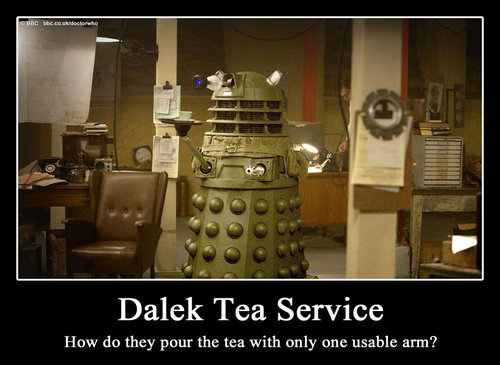
The writers have finally embraced (or at least recognized) the fact that through repetition, they've neutralized any sense of terror that the Daleks once elicited. Really, once an apron-clad Dalek offers you tea, there's no going back. Now they're the "most terrifying creatures in the universe, except when they're working as housemaids, emoting on Broadway (truly, a Dalek attempting an American accent must be the most terrifying thing a viewer can see), and blathering on about Eggs--Eggs--Eggs."

NewImage

For the Daleks to continue to be villains that are even interesting, let alone scary, the writers really need to play around with the concept. Whether they're successful or not's a different matter, but at least they're trying.

The very concept of an asylum for the Daleks never really lived up to its potential (or any real definition, for that matter). It provided a suitably creepy framework for the ultimate Human Dalek (Oswyn-lek), but the setting wasn't developed properly (I assume this is a matter of time. This story could easily have been a two-parter). After all this, I have no idea what it actually means to be an insane Dalek. You turn them on, they start shooting. Same old Eggs-terminators.

But who could help but smile at the references to Classic Who adventures with the Daleks? The City of Exxilons is a particular favorite of mine. Basically, it's the Daleks vs. the insanely creepy Exxilons versus a massive puzzle labyrinth. Also, Sarah has a mullet:

NewImage

NewImage


Business in the front, party in the back. But I digress.

Asylum of the Daleks also provided us with a surprise appearance by Jenna-Louise Coleman, recently announced to be the new companion. While I emitted a heartfelt MEH at the casting of another teenage white girl character, she totally won me over in this episode. That said, she's dead. Who knows what the real companion will be like?

And speaking of dead, why didn't the Doctor try to save Oswyn-lek? Again and again, she proves that she can exert her will over the Dalekness that attempts to control her, even at the end. These aren't the angst-filled self-recriminations of the lone ranger in Dalek, Oswyn-lek is completely, genuinely human, with all the hopes, dreams, laughter and failure of any other non-Dalek being.

I love these little moments that reveal that even the Doctor, with all his worldliness (universliness?) has moments of prejudice that he simply can't put aside. It's these little nuggets that make him seem more human, and the more complicated hero that Moffat has sort of hinted at throughout his era, but has told us about rather than shown.

Tell me, what did you think about the episode? Play along in the comments!

Read More
Posted in Doctor Who, Television, TV | No comments

Tuesday, 4 September 2012

The Devil in Silver, or, Randle McMurphy Grows Up A Little

Posted on 09:30 by Unknown

NewImage

The most enjoyable novels flirt with their weaknesses openly, forcing you to confront their arrhythmias until a) you're Stockholm Syndrome-d into acceptance or b) you cease to notice them, as the mosquito bite turns from a sharp pain to an ongoing itch.

It's been a while since I've read a novel as weirdly imperfect as The Devil in Silver. LaValle's tale of a man stuck in a mental institution (rightly or wrongly, we're never quite sure) pays tribute to its antecedents and builds upon them. He carefully constructs the institution as a real place that we can navigate in our heads, which only adds to our empathetic sense of entrapment.

Unlike one Randle McMurphy, Pepper's not the King of this castle; he's a prisoner in a rundown hospital that feels like a dystopian space station, where visions of sterility become marred by the filthiest barbed wire. It comes as no surprise that here there be monsters.

72 hours more, he repeats, ad infinitum, just 72 hours.

Time passes in strange ways and characters move in and out, though most live on past their brief appearances. Each of Pepper's institution-mates come heartbreakingly to life.they don't exist merely to justify his existence; their hopes and disappointments are real.

And yet. And yet. As I mentioned, LaValle crafts a wire straight to our empathy sensors. But he lacks confidence in his craft. At some point in the novel, he starts to include interludes from news articles on institutional abuses and other horrors. He's unsatisfied with the visceral power of the story, and hits us over the head. Luckily, these interludes are easy to ignore. And even while they leave our heads scratching, they highlight the success of the rest of the novel.

The Devil in Silver's the first novel I've read in some time that makes spending time inside the head of a middle-aged white man seem worth it. It's no coincidence, I'm sure, that Lavalle is only one of those things.

Let me know what you think in the comments.

Read More
Posted in Book Review, Books | No comments

Thursday, 9 August 2012

A Loving Note to Twin Peaks, Season One

Posted on 07:40 by Unknown

NewImage

When Laura Palmer dies, David Lynch would have us believe that even the Gods have nothing more important to do than mourn her presence. Every living body in this town, faced with the evacuation of life from Laura's strangely serene face, falls to pieces. So far, so Killing.

NewImage

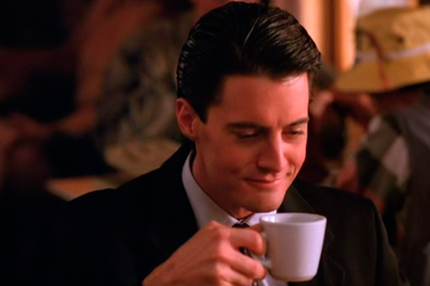
Agent Dale Cooper breezes in, a cherry-pie scented breath of fresh air, just when the weeping becomes too much to bear. Sherilyn Fenn's Audrey Horne has the good sense to laugh in the face of the rapturous weeping in the high school classroom. The audience breathes a massive sigh of relief, as we realize that Lynch/Frost intends more for our digestive-hour than the maudlin.

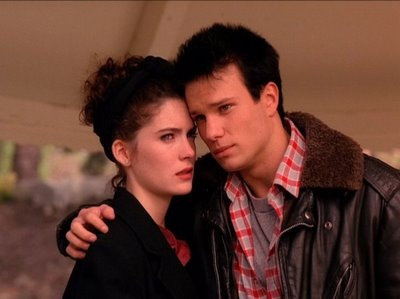
As we settle into the (admittedly strange) rhythms of the show, I genuinely can’t figure out whether David Lynch loves or hates teenage romance. All the characters are whimsically and lovingly drawn apart from Donna and James, who drip water bodies of sentiment wherever they go.

NewImage

Even Bobby Briggs, douche-jock extraordinaire, seems to have more depth to him than our drippy lovebirds. He moves easily from scene to scene, and we're never quite sure if he's operating from the high-emotional state of an adolescent teenager or from something more clinical, more mercenary. Lynch knows this; even at Bobby's most tender moments, you can always hear the frictional creaks of his faux-leather jacket.

His relationship with Shelley remains compelling even when their existential threats become more and more ridiculous, as Leo can never quite sell the idea that he's some kind of unrepentant misogynistic abuser. The more Eric DaRe tries, the more I want to laugh at his pug-nosed face and its terrible attempts at acting.

But with Twin Peaks, Lynch/Frost have achieved the impossible -- a show where bad acting actually heightens its sense of atmosphere. The gurning, the posing, even the sheer emoting, never quite seem out of place. Sure, there's a murder mystery, but who the hell cares? We want to see Dale Cooper, eccentricating himself up all over the place. We want to see Audrey Horne, Veronica Mars-ing her way through leches and peons alike.

NewImage

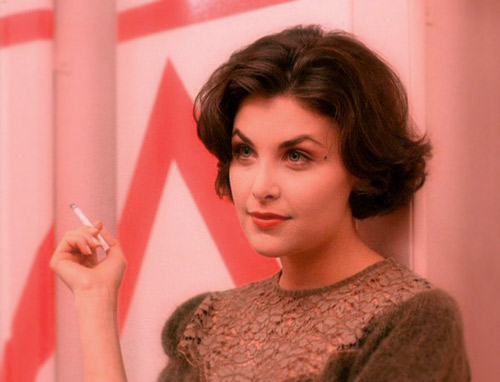
In a show full of one-armed men and dreamed up gophers, one mystery really drives the story forward. Is Audrey Horne quite real? She's everywhere and nowhere, all at once. She's all-seeing, all-knowing, impossibly beautiful, and yet she seems connected to nothing and no one apart from Agent Cooper.

I could never call him Dale. Could you?

Read More
Posted in 2012, David Lynch, Television, TV | No comments

Tuesday, 7 August 2012

A Tale of the Original Mad Men Dismemberment, or, Kisses of Death

Posted on 09:32 by Unknown

NewImage

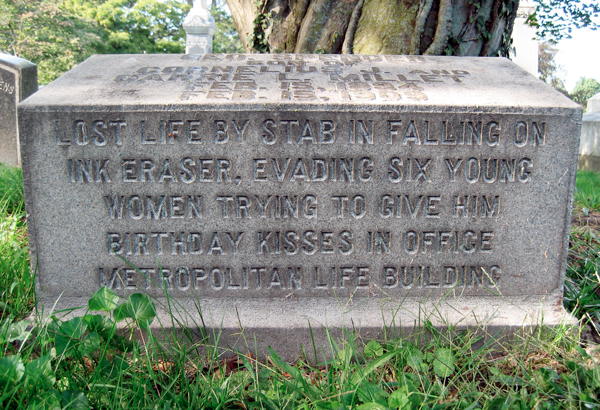
Reader, think back to one gloriously gruesome incident in S3 of Mad Men, when a rapacious Brit was sent crying (screaming) back to Blighty, feet in hand. Well, many of the tent-pole events in Mad Men are inspired by real life incidents, and I wondered, when in real life did a young man find himself so memorably dismembered in a New York office building? To the interwebs, I say!

NewImage

Once more, with feeling: "Lost life by stab in falling on ink eraser, evading six young women trying to give him birthday kisses in office Metropolitan Life Building." Poor George S. Millet lost his life in a manner most embarrassing.

Serendipity works in wonderful ways. Thank a filmmaker named Pes for discovering this tombstone in the Woodlawn Cemetery in the Bronx. In his post on Cartoon Brew, he linked a New York Times story that gets to the heart of this mysterious indoor impalement. I recommend reading the entire article (the greatest tragedies are marked with the greatest silliness), but here's the pertinent bit:

Yesterday he came down and remarked that it was the anniversary of the wreck of the Maine. He explained that he knew it because the ship had been blown up on his birthday and that he was 15 yesterday.

At once the girls began to tease him. They told him that on such an occasion he deserved a kiss, and every one of them vowed that as soon as office hours were over she would kiss him once for every year that he had lived. He laughingly declared that not a girl should get near him, and was teased about it all day.

As 4:30 o'clock came, and the boy's work was over, the girls made a rush for him. They tried to hem him in, and he tried to break their line. Suddenly he reeled and fell, crying as he did so.

"I'm stabbed!"

One might say that poor George S. Millet met the real Kiss of Death.

While I cannot be certain that this inspired the great lawnmower incident, it perfectly matches the double bill of hilarity and gore.

Read More
Posted in History, Mad Men, Manhattan Malaise, New York | No comments

Saturday, 4 August 2012

Best Book of the Year: Gillian Flynn's Gone Girl

Posted on 08:01 by Unknown

NewImage

In A Nutshell: The most perfect novel I've read this year, if not the last few years. Gillian Flynn, a unique literary voice, produces the most twisted psychological tale in recent memory, and does it with black wit and beautiful writing. All the while, she manages to make subtle and effective commentary on the nature of marriage, aging, and gender.

---

A few pages into Gone Girl, lulled into the subtle lyricism of Gillian Flynn's impeccable voice, you'll probably wonder, "How did things get so bad?" How did Nick and Amy Dunne's perfect marriage end up so mundanely terrible after such a promising start?

By the time the novel's finished, you'll wonder, "how on Earth did things get so much worse than when we started?"

Gone Girl, a masterclass in tension, plotting and character, takes you on a bumpy ride through the minds of some of the most twisted characters in recent fiction. Just when we settle into the novel's Rashomon-like storytelling (we seesaw between Nick and Amy's diary entries, his at the end of their marriage, hers at the beginning of their relationship), the cracks start to spill out of the diary entries and into reality. Little details infect the air in ways you wouldn't expect.

But Flynn's not content to leave this as a post-modern mystery for the reader to solve. At the halfway mark, she introduces a third character, one we vaguely glimpse in the first half of the novel, and one who shocks us most thoroughly. That's when things really get going. She takes all the suspense (oh, so much suspense) she built in the first half, and then lights it on fire, and the bonfire continues through the end of the novel.

I can't say anything more about the plot without spoiling the read. But I can't recommend this one enough. I freely admit that I love many books that I wouldn't recommend to all. Not Gone Girl. What Gillian Flynn achieves with form and narrative is truly worth your time.

***Spoilers***

What really impresses me about the novel is the meta-narrative sleight of hand Flynn ultimately inflicts upon us. For the first half of the book, "Nick" is merely a construction of Psychopathic Amy. By the end, Nick actually becomes "Nick," a mere character in Amy's narrative, not a real human being in his own right.

Read More
Posted in Books, Review | No comments
Newer Posts Older Posts Home
Subscribe to: Posts (Atom)

Popular Posts

  • The Good Wife In Review: "Parenting Made Easy"
  • On Kat Dennings being Fat
  • From the Horseless Sulky to Insane Modern Transport
  • Filling the Gaps: Serpico, or, Al Pacino Tries To Find A Fashionable Hat
  • 10 Years of Celebrating 9/11
  • Fashion Designers Sketch Hunger Games Dress
  • Historical Ephemera: The Secret Language of Postage Stamps
  • Poem of the Day: Robert Lax "The Alley Violinist"
  • Catching Up: X-Men: The First Class
  • Breaking Down the Hunger Games Movie Trailer

Categories

  • 2011 (1)
  • 2012 (9)
  • Abandoned (1)
  • Actresses (1)
  • Ads (1)
  • Anne Hathaway (2)
  • Architecture (4)
  • Art (7)
  • Awesome Thing Of The Day (10)
  • Birthday (1)
  • Blog Noir (2)
  • Blogathon (1)
  • blogging (4)
  • Book Review (17)
  • Books (58)
  • Breakfast Round-Up (1)
  • Brooklyn (1)
  • Bucket List (1)
  • Caine Prize (1)
  • City Lights (3)
  • Comics (1)
  • Crimes Against English (1)
  • Daily Inspiration (3)
  • David Lynch (1)
  • Dead Russians (1)
  • Death Penalty (1)
  • DFW (3)
  • Doctor Who (17)
  • Ephemera (15)
  • Epic Fail (1)
  • etc. (19)
  • Fashion (1)
  • Feature (7)
  • Feminism (10)
  • Filling the Gaps (10)
  • Film (29)
  • Film-Tech (2)
  • Fitzgerald (1)
  • Food and Drink (9)
  • Food/Drink (9)
  • Francophilia (1)
  • Friday Five (7)
  • Fringe (2)
  • Gender (2)
  • Graphic Novels (1)
  • Great Fakeout Songs (1)
  • halloween (1)
  • Health (1)
  • History (13)
  • Hit Me With Your Best Shot (1)
  • hope (1)
  • horror (1)
  • Hot Trailer (12)
  • Human Rights (1)
  • Humour (2)
  • Hunger Games (2)
  • Hurricane (1)
  • Infinite Jest (1)
  • Mad Men (3)
  • Magic (1)
  • Manhattan Malaise (1)
  • Mark Twain (1)
  • Media (4)
  • Monday Music (1)
  • Movies (56)
  • Music (21)
  • Music Video (9)
  • mystery (1)
  • New York (6)
  • Nonfiction (1)
  • Olympics (1)
  • Oscarbait 2011 (7)
  • Oscarbait 2012 (2)
  • Parks and Recreation (1)
  • Photography (5)
  • Podcasts (2)
  • Poetry (11)
  • politics (21)
  • Poster (3)
  • QOTD (1)
  • Race (4)
  • Review (8)
  • Reviewing (1)
  • Roosevelt (1)
  • Salute Your Shorts (1)
  • Sandman (9)
  • Scandal (1)
  • Sci-Fi (6)
  • Shonda Rhimes (1)
  • Short Story Book Club (1)
  • Song of the Day (4)
  • Sports (1)
  • Street-View (1)
  • Sylvia Plath (1)
  • Tech (17)
  • Television (50)
  • The Good Wife (21)
  • TV (39)
  • Twitter (2)
  • Urban Design (1)
  • Veronica Mars (1)
  • Videogames (3)
  • Vintage (1)
  • Winona Ryder (1)
  • Woody Allen (4)
  • Writing (5)
  • Year 27 (1)

Blog Archive

  • ▼  2013 (5)
    • ▼  March (2)
      • Charlotte Armstrong and the Case of the Weird Sisters
      • On the Veronica Mars Kickstarter
    • ►  February (1)
    • ►  January (2)
  • ►  2012 (105)
    • ►  December (6)
    • ►  November (9)
    • ►  October (7)
    • ►  September (5)
    • ►  August (4)
    • ►  July (12)
    • ►  June (7)
    • ►  May (12)
    • ►  April (8)
    • ►  March (13)
    • ►  February (6)
    • ►  January (16)
  • ►  2011 (190)
    • ►  December (32)
    • ►  November (31)
    • ►  October (40)
    • ►  September (36)
    • ►  August (33)
    • ►  July (18)
Powered by Blogger.

About Me

Unknown
View my complete profile